Smarter ESG, CO2 and CSRD reporting
Rydoo adapts to your reporting requirements, ensuring your data is compliant with both local and international standards.

Simple setup
Easily configure claim requirements such as distance, vehicle type, fuel usage, and check-in/out dates, and more.
Instant reporting
Collect accurate expense claims in seconds with our AI-powered mobile app, which auto-fills key expense data from receipts.
Total customisation
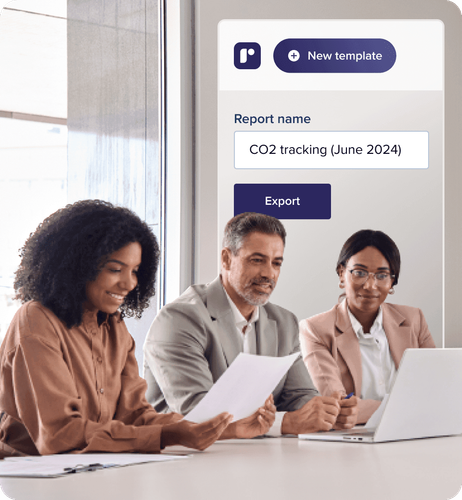
Customise your templates exactly how you need them: arrange columns, rename headers, and save your template for future use.
A simplified, centralised approach
Track
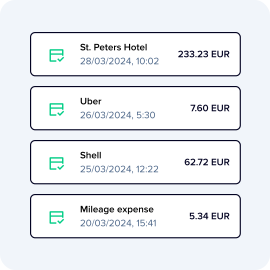
Collect detailed data on every type of employee spending through the Rydoo app.

Consolidate
Centralise all expense data for easy access and management.
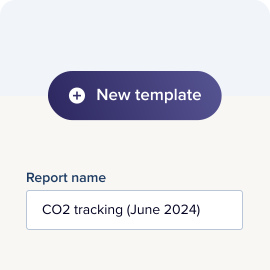
Format
Create your reusable custom export templates for CO2 tracking.
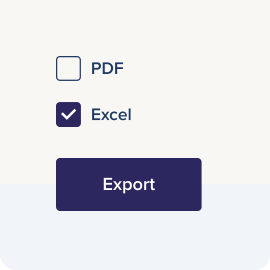
Export
Export data in the required format so you can upload it to your emission tracking platform.
Effortlessly collect travel expense data


Air travel, train, and taxi
Easily capture travel expenses with key details by logging in the journey’s start and end points, distance travelled, or travel class.


Fuel expenses
Quickly capture the fuel type and quantity for instant and traceable records. Admins have full flexibility to customise input options.


Mileage claims
Gather all the key information from mileage claims effortlessly, including vehicle type, start and end points and distance travelled.


Accomodation
Gather all the key information from mileage claims effortlessly, including vehicle type, start and end points and distance travelled.
FAQs
What is carbon accounting and why is it important?
Carbon accounting involves measuring and tracking an organisation’s greenhouse gas emissions. It helps companies comply with regulations like the CSRD, effective in the EU since 2023.
Whether mandated by law or undertaken voluntarily, carbon accounting provides organisations with valuable insights into their emissions, revealing opportunities to reduce their carbon footprint and enhance sustainability efforts.
What is CSRD, NFRD and ESRS?
The Corporate Sustainability Reporting Directive (CSRD) is an EU legislation effective from January 5, 2023. The directive requires companies to report annually on their environmental, social and governance (ESG) actions and impact.
CSRD replaces and expands the scope and detail of sustainability reporting of the previous Non-Financial Reporting Directive (NFRD).
The European Sustainability Reporting Standards (ESRS), effective from January 1, 2024, specify the CSRD reporting requirements. These standards provide a framework for companies to report on ESG topics in a standardised and comparable manner, ensuring transparency and consistency in sustainability reporting across the EU.
Who needs to report under the CSRD and when?
Under the CSRD, the reporting requirements are phased in over several years based on company size and listing status:
- From January 2025, companies already subject to the NFRD, which includes large companies with over 500 employees listed on EU-regulated markets, must report on their 2024 sustainability performance;
- From January 2026, large companies meeting at least two of the following criteria—250 or more employees, €50 million in turnover, or €25 million in total assets—must report for the 2025 financial year;
- From January 2027, listed SMEs that meet at least two of these criteria—50 to 250 employees, €10 to €50 million in turnover, or €5 to €25 million in total assets—will need to report for the 2026 financial year;
- From January 2029, non-EU companies with a significant presence in Europe (e.g., a turnover exceeding €150 million in the EU) must begin reporting on their 2028 financial year.
How does Rydoo help with carbon accounting and CSRD compliance?
Rydoo supports carbon accounting and CSRD compliance by accurately tracking and centralising expense data for travel, fuel, and other business expenditures. It enables users to capture the exact data they need, consolidate it into comprehensive reports, and effortlessly upload them to emission-tracking platforms, regulatory bodies, or their own systems.
The data capture and reporting formats can be customised to meet each company’s specific requirements and compliance needs.
Discover more Rydoo features


AI expense policy assistant
Answers employee policy questions instantly, before a claim is submitted.


A secure environment for your data